Staying Connected With Every Household: Building a Consistent Family Contact Rhythm
Learn how to build a simple, sustainable rhythm of personal contact so every family in your church hears from someone who cares, not just the ones who are struggling or most visible.
The Families No One Is Calling
In most churches, pastoral contact follows need. Someone goes into the hospital, a baby is born, a family loses a loved one, and the church shows up. That's good and right. But it leaves a quiet gap: the steady, faithful households who never seem to be in crisis often go months, sometimes years, without a personal conversation with anyone from their church.
Those families aren't fine just because they aren't asking for help. Many are carrying burdens they haven't mentioned, wondering whether anyone would notice if they stopped coming. A consistent rhythm of family contact closes that gap. It means every household hears from someone who cares on a regular basis, not only when something goes wrong.
Why Consistency Matters More Than Intensity
A single heartfelt visit is meaningful. But a simple check-in every couple of months, sustained over years, builds something deeper: trust. When families are used to hearing from their church, they're far more likely to reach out when life gets hard. The relationship already exists, so asking for help doesn't feel like an imposition.
Consistency also protects against drift. Families rarely leave a church all at once. They slip away slowly, missing a few Sundays, then a month, then a season. Regular contact catches those early signs while there's still a relationship to lean on.
Decide on a Realistic Rhythm
The best contact plan is the one your team can actually keep. Start by choosing a cadence that fits your size and your people:
- Small churches (under 100): A pastor or a couple of elders can often reach every household once a quarter.
- Mid-sized churches (100–500): Divide the congregation among a care team or group leaders, aiming for contact every two to three months.
- Larger churches: Lean on small group leaders and ministry teams as the first line of contact, with staff focusing on those not connected to any group.
It's better to commit to every 90 days and follow through than to promise monthly calls and quietly give up by spring.
Share the Load Wisely
No single pastor can shepherd an entire congregation alone, and they were never meant to. Building a care team spreads the work and multiplies the relationships. A few principles help:
- Assign families, not tasks. Give each caller a specific list of households they're responsible for. Ownership matters; "someone should call the Johnsons" usually means no one does.
- Keep lists manageable. Ten to fifteen households per person is a sustainable load for most volunteers.
- Match thoughtfully. Pair young families with people in a similar season of life, or older members with someone patient and unhurried.
- Rotate occasionally. Fresh eyes can notice things a long-time caller has stopped seeing, but avoid shuffling so often that relationships never form.
Make Each Contact Count
A family contact doesn't have to be long or formal. A five-minute phone call, a handwritten note, or a quick text can all be meaningful. What matters is that it feels personal rather than procedural. Give your team a few simple prompts:
- "How has your family been doing lately?"
- "Is there anything we can be praying about for you?"
- "Is there anything the church could do better for your family?"
Encourage callers to listen more than they talk. Many families have never been asked these questions directly, and the conversation can open doors no announcement ever would.
Keep a Simple Record
Without some form of tracking, even the most committed team loses its place. Who was contacted last month? Who couldn't be reached? Did anyone mention a new job, a health concern, or a child heading off to college? A brief note after each contact turns scattered conversations into real shepherding.
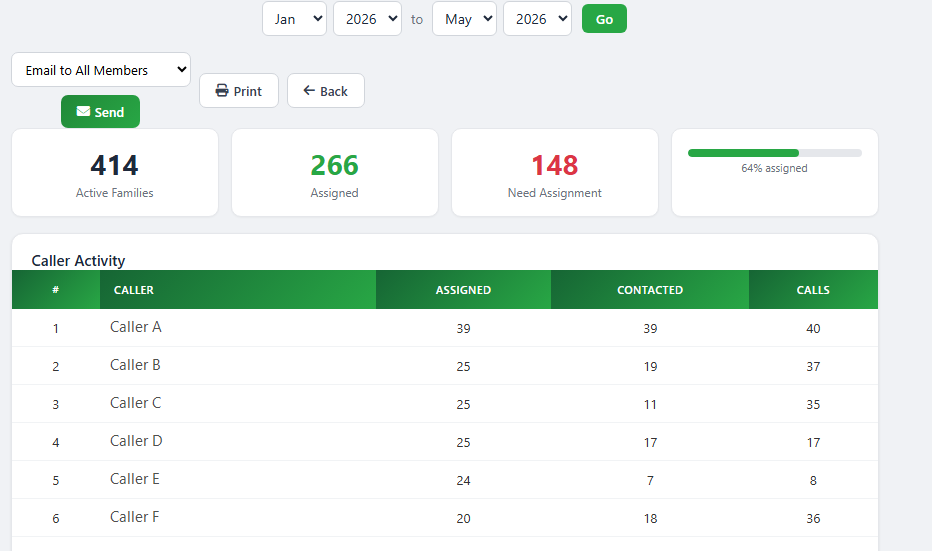
Your record doesn't need to be elaborate. Capture the date, the method of contact, and anything worth following up on. Then review it regularly to spot households that haven't been reached in a while. Some churches manage this with a shared spreadsheet; others use a tool built for the purpose. Platforms like You Matter are designed to help churches see at a glance which families are due for contact and keep care notes in one place, so nothing depends on any one person's memory.
Whatever you use, be thoughtful about privacy. Notes about health or family struggles should be visible only to those who truly need them.
Review and Adjust Together
Every few months, gather your care team to reflect. What patterns are you noticing? Are certain families consistently unreachable? Are callers feeling stretched thin? These conversations keep the rhythm healthy and give your team a chance to share encouraging stories, which is often what keeps volunteers going.
Also watch for families who need more than a routine check-in. A consistent rhythm makes those moments easier to spot, and it means your pastors can respond quickly with deeper care.
Small Steps, Lasting Relationships
You don't need a perfect system to start. Choose a cadence, divide the households, give your team a few good questions, and keep a simple record. Over time, those regular touches add up to a church where every family knows they're seen and remembered.
That kind of steady care rarely makes headlines, but it's often what keeps people rooted in a community of faith. And it reflects something true about the Good Shepherd, who knows each of His sheep by name.